A book in development by Allan Adler

Systems of Intelligence:Human/AI Symbiosis

How Humans and AI Transform Work Without Surrendering Human Sovereignty

AI transforms consequential work when leaders redesign the bounded System of Intelligence and deliberately develop and govern the human–AI relationship inside it.

The book asks whether the work and the people doing it can become more capable together without surrendering human judgment, agency, or responsibility.

Humanpurpose · judgment
authority · responsibility
AIreach · speed
memory · generation
SYMBIOSISlearning to achieve
consequential
outcomes together

inside a governed
System of Intelligence

The problem

A company can deploy AI everywhere and still leave the system of work unchanged.

The platforms are live. Employees have copilots. Leaders count use cases, training, and adoption. Yet decisions still stall, expertise remains trapped in a few heads, handoffs still fail, and no one can show which consequential condition improved.

AI expands what people and machines can contribute. Leaders still have to decide which work matters, how each participant should contribute, who may act, what the work must remember, and how the organization will learn from results.

The unit of transformation

Change the system that turns intelligence into consequence.

A System of Intelligence is a bounded work system that turns information and experience into decisions, action, and learning toward a consequential purpose.

Every organization already has them. They include people, practices, artifacts, data, machines, decision rights, actions, and the evidence through which the work changes over time.

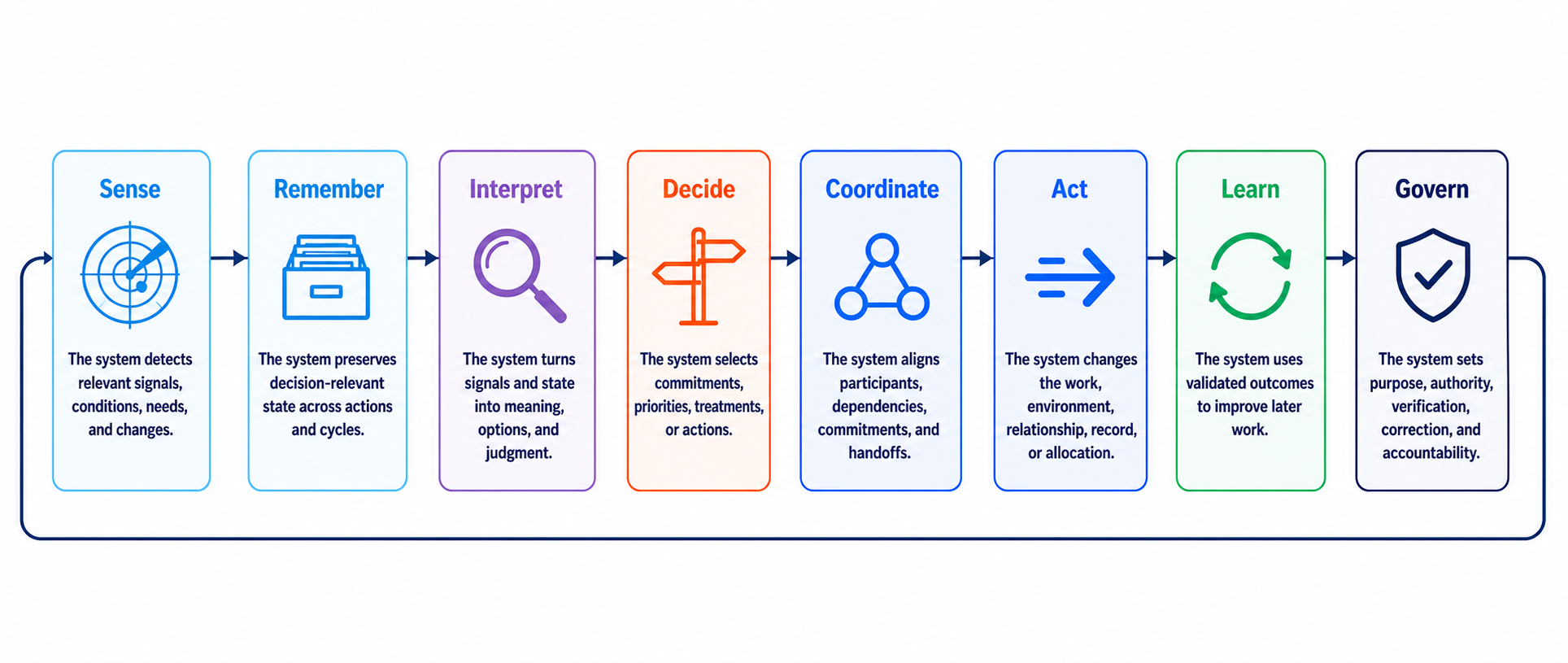
The eight connected functions of a System of Intelligence: Sense, Remember, Interpret, Decide, Coordinate, Act, Learn, and Govern.
Eight connected functions turn signals and state into governed action and learning.

The mechanism at the center of the book

A human–AI combination becomes symbiotic when the relationship learns from consequences.

The System of Intelligence is the bounded consequential work. The symbiosis is the developing relationship through which people and AI contribute inside it.

A Symbiotic System of Intelligence deliberately combines people and AI inside consequential work, learns from what that work does, improves both the work and the relationship, and remains governed by human purpose, judgment, and authority.

01 · The system trajectory

Does the relationship improve consequential performance?

Test decisions, action, adaptation, resilience, and the credible path to advantage. Output volume and adoption do not answer this question.

  • Decisions and action improve.
  • The system learns from consequences.
  • The system adapts as conditions change.
THE QUALITY OF
THE RELATIONSHIP
participation · context
challenge · correction
authority · adaptation
02 · The human trajectory

What does the relationship do to the people inside it?

Test agency, judgment, capability, well-being, responsibility, dissent, and practical authority. Safeguards cover only part of this question.

  • People retain the capacity to perform.
  • People retain the capacity to govern.
  • People develop the capacity to evolve.

How the relationship improves

The work and the relationship learn from the same consequences.

The work must learn from what it does. The relationship must learn from how people and AI contributed, challenged, relied on one another, and corrected mistakes. People govern both forms of learning.

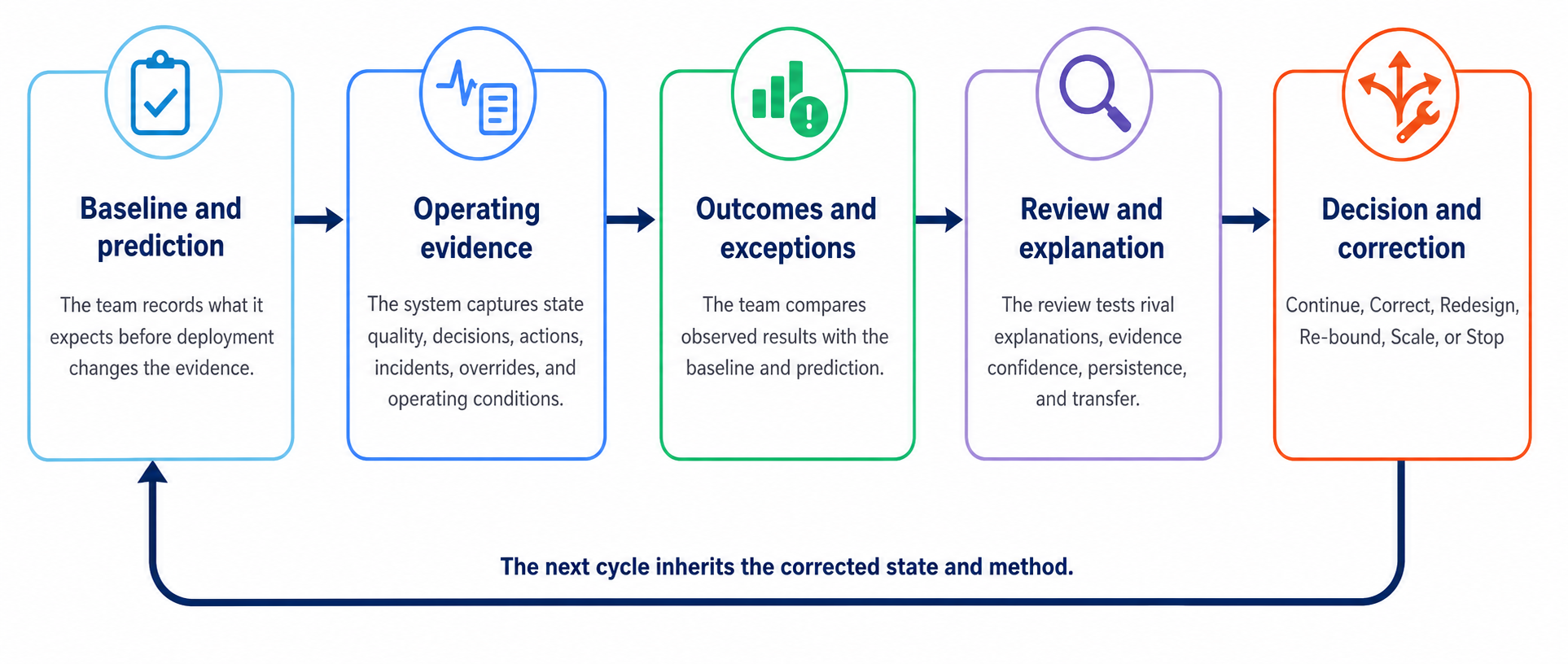
An evidence-learning loop moves from baseline and prediction through operating evidence, outcomes and exceptions, review and explanation, and decision and correction before the next cycle.
The operating evidence trail makes correction inspectable and gives the next cycle a better starting point.

A defining human capability

Symbiotic competency is the human capacity to shape the relationship.

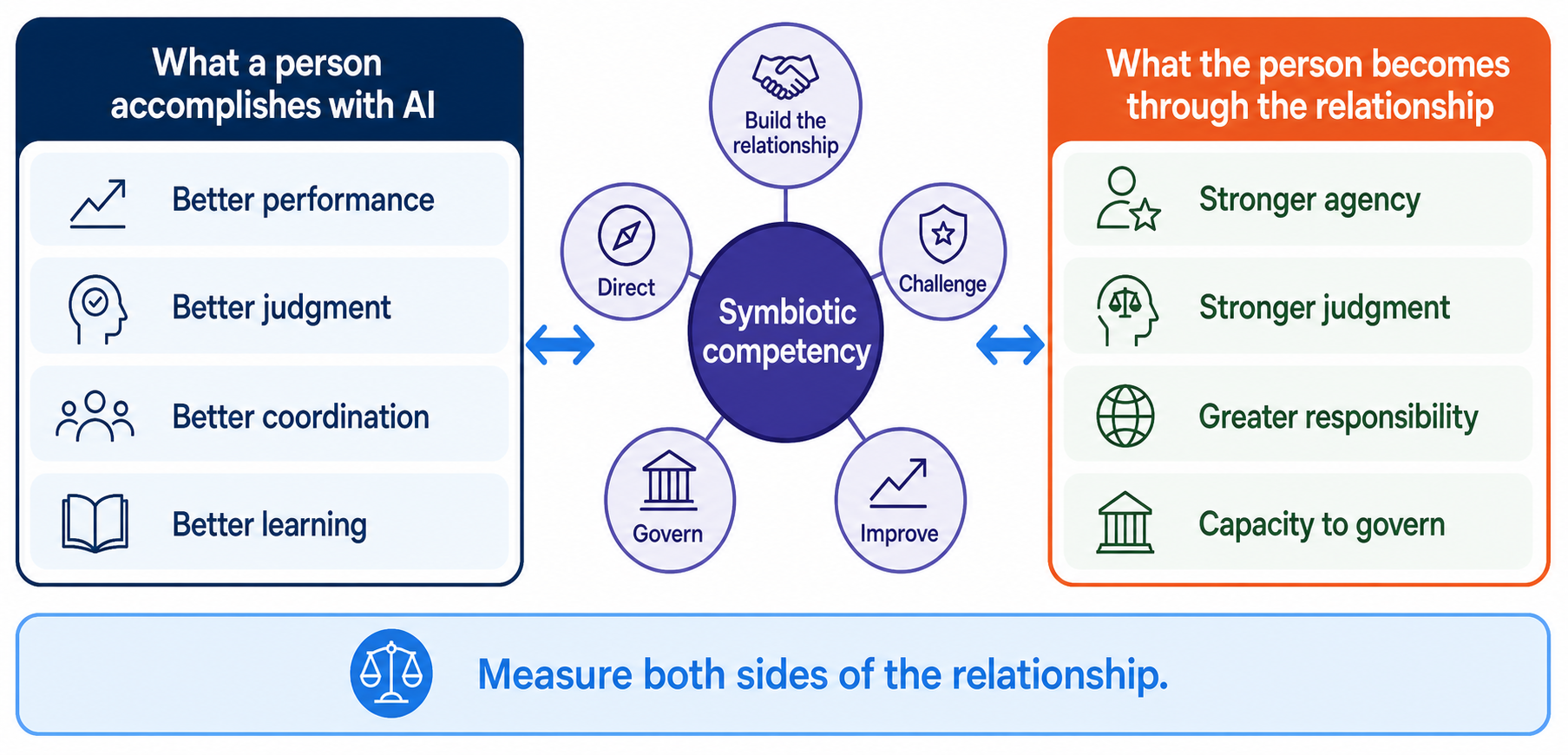
Symbiotic competency is the measurable capacity to build, direct, challenge, govern, and improve a working relationship with artificial intelligence while strengthening human judgment, agency, and responsibility.

The book proposes symbiotic competency as a measurement standard to be validated. It is not yet an established employment measure.

Symbiotic competency connects what a person accomplishes with AI—better performance, judgment, coordination, and learning—with what the person becomes through the relationship—stronger agency, judgment, responsibility, and capacity to govern.
Symbiotic competency must strengthen both the work and the person doing it.

Inside the book

Twelve chapters develop one causal argument.

Open any chapter to see the work it does and the questions it answers. Chapters 1–7 are complete working manuscripts.

01

Recognition

See why deployment activity can leave consequential work unchanged.

01The Company That Deployed Everything and Changed NothingAI everywhere. Transformation nowhere.Complete+

A company has platforms, copilots, use cases, training, and a green adoption dashboard—yet important work still moves through the same bottlenecks. The chapter separates deploying capability from changing a consequential work system, then introduces the joined proposition: the System of Intelligence is the bounded work; symbiosis is the developing human–AI relationship inside it.

Questions the chapter answers
  • Why does more AI so often produce so little structural change?
  • What must leaders redesign besides technology?
  • Why do SOI and symbiosis have to enter together?
02What Actually TransformsChange is structural. Success is a separate test.Complete+

Transformation occurs when the configuration of consequential work changes—not when a tool is installed or a task becomes faster. The chapter gives leaders a seven-question profile for distinguishing activity from structural change, and structural change from worthwhile change. It ends by exposing the missing object that must be bounded before it can be redesigned.

Questions the chapter answers
  • What changed in the work itself?
  • Did the change improve a consequential outcome?
  • What evidence would show that the transformation succeeded?
02

The mechanism

Define the work system, the relationship, and the evidence through which both improve.

03Your Company Already ThinksEvery organization already has systems that turn experience into action.Complete+

The company’s intelligence becomes visible as a bounded work system with purpose, participants, operating state, rhythm, authority, and consequence. Eight functions—sense, remember, interpret, decide, coordinate, act, learn, and govern—show what the system must accomplish. The chapter distinguishes the real operating system from its maintained representation and introduces symbiosis through the work people already do.

Questions the chapter answers
  • Where does this work system begin and end?
  • What state must persist between cycles?
  • How do rhythm and operating loop differ?
04The Symbiotic System of IntelligencePeople and AI do not become complementary merely by being combined.Complete+

This chapter defines the book’s distinctive mechanism. It asks what each participant contributes, how those capabilities should combine, and who holds authority. It introduces symbiotic competency and the two-sided test: what the coupling does to consequential performance and adaptation, and what it does to human agency, judgment, capability, well-being, responsibility, and practical authority.

Questions the chapter answers
  • What can each participant contribute?
  • How should the relationship challenge and correct itself?
  • Does better performance also strengthen human capacity?
05From Signal to ConsequenceThe system learns from what its work actually does.Complete+

A hospital operating cycle shows signals becoming interpretation, decision, action, and consequence. The work-learning loop improves the system’s results; the relationship-learning loop improves how people and AI participate, exchange context, rely, challenge, and correct. Human governance connects the loops and prevents either one from expanding its own purpose, boundary, or authority.

Questions the chapter answers
  • What changed after the consequence arrived?
  • What did the result reveal about the human–AI relationship?
  • Which changes require renewed human authorization?
03

The instruments

Redesign work patterns, locate where change occurs, and connect strategy with operating evidence.

06The Grammar of WorkThe unit of design is the work pattern—not the use case.Complete+

The chapter teaches a four-question grammar: how cognition is organized, how labor is divided, how work is coordinated, and how authority is governed. It separates participation design from authority design and shows why a Second Brain can supply continuity and capabilities without becoming the System of Intelligence or the work pattern. Readers learn to invent patterns, not simply select from a catalogue.

Questions the chapter answers
  • Who contributes what to the work?
  • Who may direct, decide, execute, correct, and answer?
  • What should be maintained, retrieved, reconstructed, regenerated, or forgotten?
07Where the Change Lands — and Why It Lands Differently in Your BusinessThe same AI capability produces different consequences in different work systems.Complete+

The chapter follows transformation across twelve industries and into different business contexts. It explains why the bounded work system—not the industry label—is the unit of change; how Systems of Intelligence nest and overlap; and what must be true before a method, skill, or human–AI capability can transfer. The Transformation Map, capability ladder, and nine-question transfer test separate individual symbiosis, candidate team symbiosis, organizational symbiotic capability, and the still-unproven hypothesis of organizational symbiosis.

Questions the chapter answers
  • Where does the change land in this business?
  • What transfers across systems—and what must remain local?
  • How can several human–AI relationships become an organizational capability?
08From Strategy to Outcome — and BackStrategy becomes testable when it enters a governed operating loop.Planned+

This chapter connects enterprise intent to bounded work, operating hypotheses, evidence, and renewal. It shows how strategy changes the systems below it and how consequences from those systems travel back upward without becoming dashboard theatre. The result is a practical bridge between direction and daily work.

Questions the chapter answers
  • How does strategy become a testable operating hypothesis?
  • What evidence travels upward?
  • When should results change the strategy itself?
04

Human authority & development

Build the human capacity to understand, direct, correct, and govern the system.

09The Player-Coach Governs the LoopGovernance requires situated competence, not ceremonial approval.Planned+

The player-coach participates closely enough to understand the system’s competence frontier while retaining legitimate authority to question, redirect, constrain, correct, and stop it. The chapter decomposes authority and surrounds situated governance with accountable leadership, independent review, and contestability for people affected by the system.

Questions the chapter answers
  • Who can actually correct the system?
  • Where is authority delegated—and can it be revoked?
  • How does oversight remain independent without becoming remote?
10What We Refuse to Give UpGreater capability can coexist with growing human fragility.In development+

The chapter tests whether people retain the capacity to perform, govern, and evolve as AI participation grows. It examines dependence, brittleness, judgment, agency, dissent, well-being, and responsibility. The standard is demanding: measure both what people accomplish with AI and what they become through the relationship.

Questions the chapter answers
  • Are people becoming more capable or merely more dependent?
  • Can accountable people still understand, direct, correct, and replace the system?
  • What human capacities must never become accidental externalities?
05

The stakes

Test whether the capability becomes durable advantage—and whether the theory survives evidence.

11The Intelligent EnterpriseCapability is not advantage until it becomes scarce, captured, and durable.Planned+

The book’s practical argument culminates in a four-gate advantage test. The chapter asks whether the new capability creates value, whether competitors can readily copy it, whether the organization can capture the value, and whether the advantage survives turnover, technology substitution, and time. Symbiotic competency is treated as a possible complementary asset—not an assumed moat.

Questions the chapter answers
  • Does the capability create consequential value?
  • Why can’t competitors simply buy the same result?
  • What makes the advantage durable rather than temporary?
12How This Could Be WrongA causal theory earns trust by naming its rivals and its falsifiers.Planned+

The final chapter states where the evidence is strong, where it is provisional, and what findings would force the theory to change. It tests rival explanations, the limits of transfer, the pattern grammar, the learning mechanism, and the advantage claim. The book ends with disciplined ambition: build greater intelligence while remaining honest about what has—and has not—been demonstrated.

Questions the chapter answers
  • What evidence would falsify the mechanism?
  • Which claims remain hypotheses?
  • What would require a major revision rather than a footnote?

A note from the author

The question is what all this intelligence is for.

Making sure AI contributes to the well-being of organizations, people, and the planet may be one of the greatest contributions any of us can make. I have committed the next stage of my work to that purpose.

This book is my first step. I am trying to define how human–AI symbiosis can help organizations accomplish more while strengthening human judgment, agency, responsibility, and well-being, and while taking seriously the effects those organizations have on the living world around them.

I do not assume AI will get us there on its own. We have to decide what we want the relationship to contribute, design the work around that purpose, keep human authority visible, and test the results against real consequences. Systems of Intelligence give us a mechanism for doing that: they bound the consequential work, name the participants and their authority, preserve what the work knows, and use evidence from results to improve both the work and the human–AI relationship.

My commitment is simple. I want greater intelligence to help organizations serve people and the planet more fully. This book is where I begin.

— Allan Adler
The book became a living case

We built the thing the book is about.

AI has been an unbelievable book-writing companion for me. As we worked, our collaboration became the human–AI symbiosis the book describes. Around it, we built an authoring System of Intelligence that holds the research, remembers decisions, protects continuity, and learns from correction.

The book is the consequential work. If Allan / AI collaboration and the system are improving, those improvements have to produce a clearer argument, stronger evidence, and a better book.

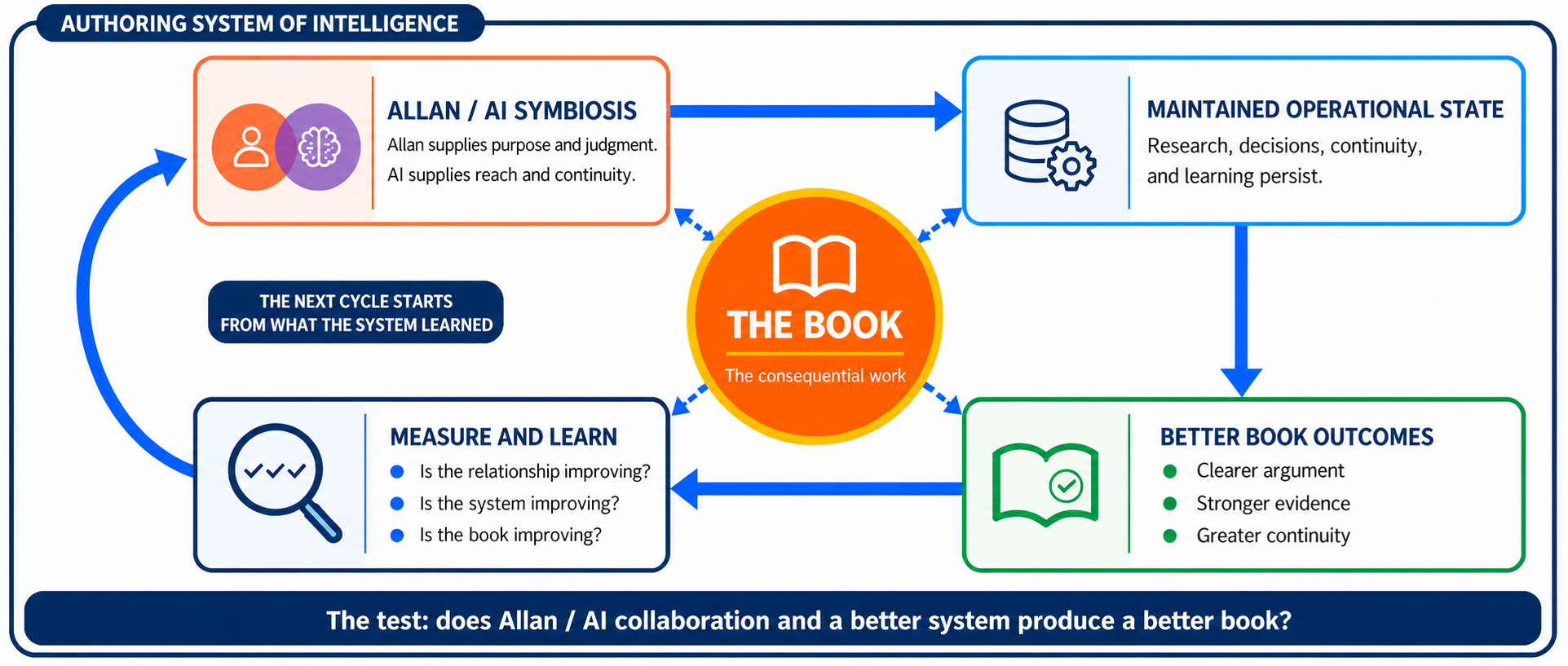
The authoring System of Intelligence places the book at the center as the consequential work. Allan and AI improve the maintained operational state, the system supports better book outcomes, and measurement asks whether the relationship, the system, and the book are improving.
The test: does Allan / AI collaboration and a better system produce a better book?
01
Allan / AI symbiosis

Purpose and judgment combine with reach and continuity.

02
Maintained operational state

Research, decisions, continuity, and learning persist.

03
The book

The book is the consequential work.

04
Better book outcomes

The argument, evidence, and continuity improve.

05
Measure and learn

Test the relationship, the system, and the book, then carry what we learn into the next cycle.

The test: does Allan / AI collaboration and a better system produce a better book?

Working on the book improves our relationship. The relationship improves the system. The improved system gives us a better starting point for the next cycle.

This may point toward a new kind of author: the Symbiotic Author.

This is a documented, author-observed case—not independent validation.

Join the inquiry

Help test whether human–AI symbiosis can improve work without diminishing the people responsible for it.

I am sharing the book's evidence, revisions, and mistakes as the manuscript develops. Follow the book as it tests its theory in the system being used to write it. If you are redesigning consequential work, I would like to hear what is working, what is failing, and what this theory misses.

Follow or contribute to the work